AEO vs SEO vs GEO: what B2B teams need to know
SEO, AEO, and GEO are mostly the same work, aimed at different results. Here is what changes, what stays the same, and what B2B teams can stop paying for.
What is the difference between AEO, SEO, and GEO?
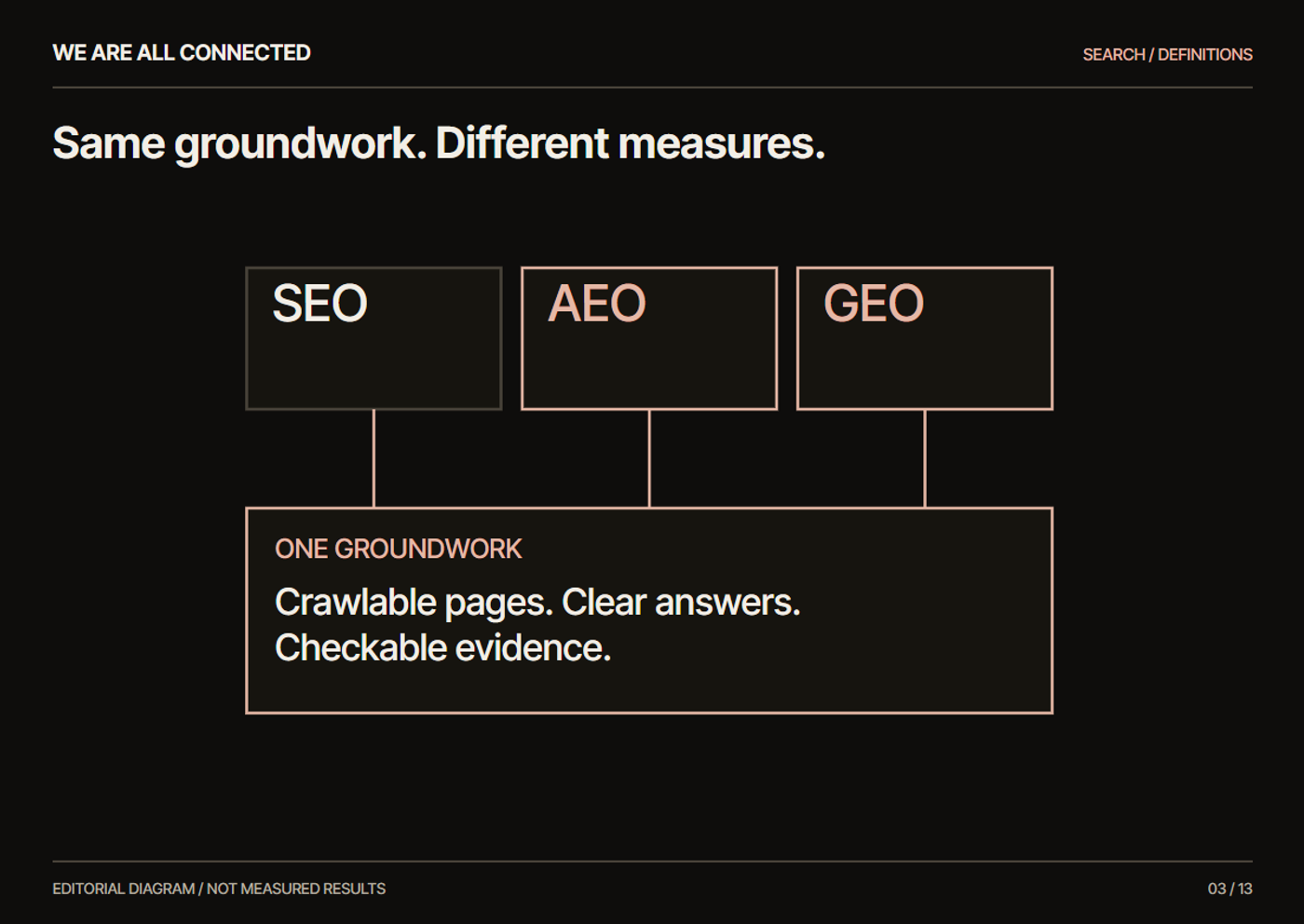
SEO, AEO, and GEO are mostly the same work, aimed at different results. SEO (search engine optimisation) aims for a high position in search results. AEO (answer engine optimisation) and GEO (generative engine optimisation) aim for a citation inside an AI-generated answer. At We Are All Connected we treat AEO and GEO as one discipline built on SEO groundwork. What changes most is how you measure success.
What are AEO, SEO, and GEO?
What is SEO?
Search engine optimisation (SEO) is the work of making a website easy for search engines to crawl and rank for the questions buyers type. It’s usually measured by ranking position and by the clicks and enquiries that follow. AEO and GEO both build on it.
What is AEO?
Answer engine optimisation (AEO) is SEO aimed at being cited inside AI-generated answers - on surfaces such as Google AI Overviews and AI Mode, ChatGPT, and Perplexity. We describe it as SEO with the citation as the unit of attention. We couldn’t find a reliable origin for the term; it emerged from the search industry.
Where does GEO come from?
Generative engine optimisation (GEO) comes from an academic paper, "GEO: Generative Engine Optimization" by Pranjal Aggarwal and colleagues, first posted in November 2023 and accepted to KDD 2024. The authors use it for changes content creators can make to be more visible in AI-generated answers. Vendors have since taken up the term, often interchangeably with AEO. We will cover the research in a separate GEO explainer.
What changes between AEO, SEO, and GEO?
Three things change: what you measure, where the answer appears, and how answers are put together. The research behind GEO also says something about what a good page contains.
Measurement. SEO reports a position in a list. AEO asks whether your brand is cited inside the answer across a defined set of buyer prompts, and how that share moves month to month. In our experience the same prompt can return a different answer tomorrow; as our service page puts it, "AI retrieval is probabilistic, not deterministic." So one score means little without a trend and a stated range. Our audit runs in four stages - Eligibility, Exposure, Engagement, and Outcome - starting with whether AI bots can reach your pages at all.
Surfaces. AEO and GEO work shows up as a cited source inside Google's AI Overviews and AI Mode, and inside assistants such as ChatGPT and Perplexity, where the buyer reads a written answer with a few links attached.
Assembly. Google says AI Overviews and AI Mode may use a "query fan-out" technique, "issuing multiple related searches across subtopics and data sources" to build a response. So one buyer question can turn into several searches, and the answer can draw on several pages. Our view is that a page that clearly answers one of those smaller questions could be cited even when it does not rank first for the broader query; we set out that argument in our post on the passage-first content model.
What the research tested. In the GEO paper's own tests, first published in 2023, the "top-performing methods, Cite Sources, Quotation Addition, and Statistics Addition, achieved a relative improvement of 30-40% on the Position-Adjusted Word Count metric". Keyword stuffing, common in SEO, gave "little to no improvement". The authors also found that "the efficacy of these strategies varies across domains". These are results from a research benchmark. They do not show how Google's AI Overviews or ChatGPT behave today. They are still the best evidence we have seen behind any content tactic in this area, and they point towards writing that other people can check.
What stays the same?
The foundations stay the same, and Google says as much for its own search. "The best practices for SEO continue to be relevant because our generative AI features on Google Search are rooted in our core Search ranking and quality systems." Its page on AI features adds: "There are no additional requirements to appear in AI Overviews or AI Mode, nor other special optimizations necessary." Google documents this for its own AI features only. OpenAI and Perplexity publish less about how they choose sources, so for those assistants it is our working view that the same groundwork applies.
In our experience, the work that matters for rankings also matters for citations. Crawlers need to reach and index the page, and the page needs to answer a real question with evidence a reader can check. Your company name and core facts should match wherever they appear, on your site and off it.
Pedro Dias made a similar point about GEO in Search Engine Journal in May 2026. "'Technical GEO' is the SEO playbook with different stickers on the same boxes, sold against research that points the other way." Our own service page says: "Most of what's now sold as AEO is the old SEO playbook with a new acronym."
How do AEO, SEO, and GEO compare?
SEO
- What it optimises for: Ranking for queries
- Where it shows up: Classic search results
- What you measure: Position and the clicks that follow
- The typical sales pitch: Rank higher and win more traffic
- What we think: The foundation; AEO and GEO build on it
AEO
- What it optimises for: Being cited in AI answers
- Where it shows up: AI Overviews, AI Mode, ChatGPT, Perplexity
- What you measure: Citation share across prompts, over time
- The typical sales pitch: Get your brand into ChatGPT answers
- What we think: SEO plus a measurement layer; worth tracking
GEO
- What it optimises for: Visibility in generative engine responses
- Where it shows up: The same AI answer surfaces
- What you measure: In the paper, a word-count-based visibility score; in practice, the same as AEO
- The typical sales pitch: Optimise for generative AI, backed by research
- What we think: Interchangeable with AEO; the name comes from a 2023 paper
What should a B2B team do?
- Get eligible first. Check that robots.txt and any firewall or bot-management rules are not blocking AI crawlers, and that the pages you care about are indexable, because nothing downstream works if a page cannot be fetched.
- Write passages that answer the questions buyers ask AI assistants. Open each section with a direct answer that makes sense on its own, because Google says its AI features may run several related searches to build one answer, and in our view a clear, self-contained passage is the easiest thing to cite for one of them. That does not mean chopping pages into fragments. Google: "There's no requirement to break your content into tiny pieces for AI to better understand it."
- Put checkable evidence on the page. Cite your sources and give figures with their origin, because in the GEO paper's research benchmark, adding citations, quotations, and statistics did the most for visibility.
- Be present where AI assistants look for names. This one is our working view; no platform documents it as a rule. Industry lists, directories, review sites, and trade press give an assistant somewhere besides your own site to find you.
- Measure citation share over time. Track a fixed set of buyer prompts each month and report a range alongside the headline figure, because answers vary from one run to the next. Our AEO tooling guide sorts the tools by the layer they work on.
- Stop paying for the folklore below. Budget spent there could go to the first five steps instead.
What should you ignore?
- Schema as an AEO lever. For Google's AI features, Google says: "Structured data isn't required for generative AI search, and there's no special schema.org markup you need to add." Other assistants publish little on this. Keep schema clean as hygiene, and do not buy it as a route to citations.
- llms.txt. Google says you don't need "new machine readable files, AI text files, markup, or Markdown" (which covers llms.txt) to appear in Google Search, "as Google Search itself doesn't use them". Ahrefs found that "of the ~38,000 domains with a valid file, 97% saw no requests for it whatsoever" in May 2026. More in why llms.txt does almost nothing for AI search.
- Magic word counts. Google: "There's no ideal page length." The same goes for answer blocks, so write each answer as long as it needs to be.
- FAQ markup for rich results. Google limited the FAQ rich result in 2023 to "well-known, authoritative government and health websites", then retired it: "This feature will no longer appear in Google Search starting May 7, 2026."
FAQ
Is AEO just SEO with a new name?
It is mostly SEO, with a new way of measuring results. Google says SEO best practices still apply to its AI features and that no special optimisation is needed to appear in them. The real change is in reporting: you track how often AI answers cite you across a set of buyer prompts, month by month.
Do I need a separate AEO agency?
Usually not. If your SEO partner already checks crawler access and writes pages that answer buyer questions directly, ask them to add citation tracking; that covers most of what AEO adds. Be wary of anyone selling schema or llms.txt as the route to citations; Google says its AI features need neither.
Is GEO the same as AEO?
In practice, yes. GEO started as an academic term in a 2023 paper; AEO grew up inside the search industry, and vendors now use both for the same work. We Are All Connected treats AEO, GEO, and "AI SEO" (a third label for the same thing) as one discipline.
Related reading
- How to do AEO properly in 2026
- Answer Engine Optimisation for B2B
- AEO tooling in 2026: 160 products checked against their own pages, sorted by the layer they work on
- The passage-first content model: what's real, what's ritual
- Why llms.txt does almost nothing for AI search
Sources
- Google Search Central: AI features and your website
- Google Search Central: Optimizing your website for generative AI features on Google Search
- Pedro Dias, Search Engine Journal: The Whole Point Was The Mess
- Aggarwal et al.: GEO: Generative Engine Optimization (arXiv 2311.09735)
- Google Search Central: What's new (FAQ rich result removal)
- Ahrefs: We Analyzed 137K Sites: 97% of llms.txt Files Never Get Read
Want to make this practical?
Book a call and we will walk through your current stack, what is worth wiring first, and what should wait.
Book a call