Does AI content save money once review and rework are included?
A faster first draft can leave the bills for review and corrections untouched. Two blank worksheets help you compare what each accepted article costs.
Imagine a writer hands in an article a day early. A product specialist then spends the afternoon correcting a claim, and an editor replaces two sources that say something different from the draft. The writer saved time. What did the article cost?
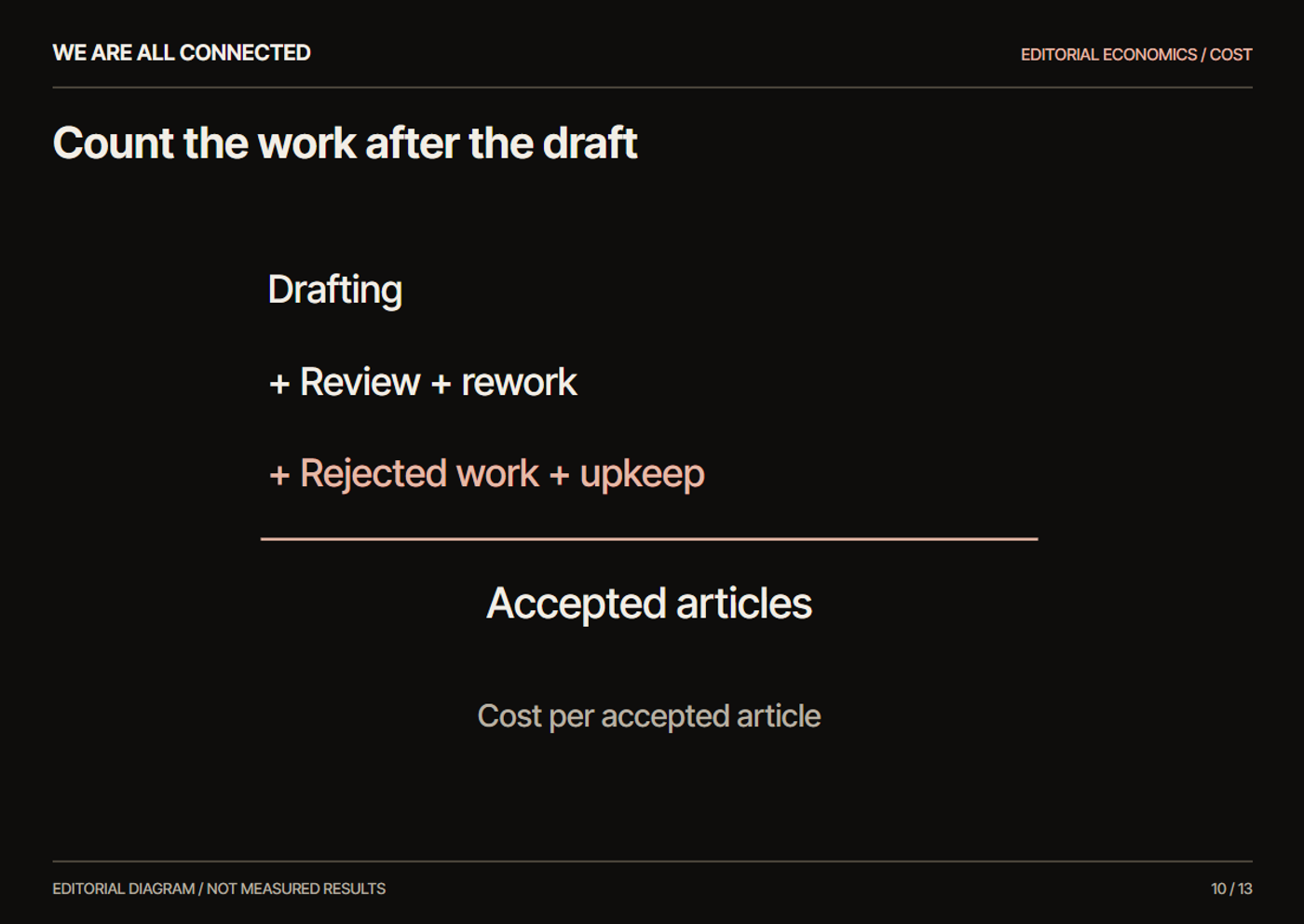
We would measure the total cost per accepted article. Add the cost of everything the team took on, including rejected briefs and later corrections. Divide by the number of articles that met the agreed standard. Research can tell us how quickly participants finished a writing task. For the cost of publishing a specialist B2B article, you need your own figures.
Start with a small comparison.
- Pair similar briefs. Assign one brief in each pair to a writer using AI and the other to a writer working without it.
- Give both articles the same expert review and use the same written rules for acceptance.
- Log the whole job, including unsuccessful drafts and 30 days of upkeep on each accepted article.
What did the writing experiment measure?
In a preregistered writing experiment, Shakked Noy and Whitney Zhang gave professionals occupation-specific writing tasks. Across 453 participants, access to ChatGPT reduced average task time by 40%. Evaluators rated the resulting work 18% higher on average.
The authors’ earlier working paper describes short assignments that required little context-specific knowledge. A product specialist checking an article against the latest release notes is doing a different job. The experiment never measured that specialist’s time.
Where can a faster draft still go wrong?
Fabrizio Dell’Acqua and colleagues studied 758 Boston Consulting Group consultants. Among the 385 assigned a set of 18 tasks suited to GPT-4, AI users completed 12.2% more tasks and took 25.1% less time. Their work also received higher quality ratings.
The other 373 consultants had to weigh interviews against quantitative data. With AI, they were 19 percentage points less likely to reach the correct solution. The same tool had helped on one kind of work and hurt performance on another.
An editor can test that distinction. Take one polished paragraph, open its source, and ask whether the number refers to the same people, period and outcome. A high score for readability buys you nothing if the paragraph misquotes its evidence.
Whose time did you save?
A study of 5,172 customer-support agents found that access to an AI assistant increased the number of issues resolved per hour by an estimated 15% on average. Researchers used a staggered rollout, so this was an estimate from a workplace deployment.
Less experienced and lower-skilled agents gained in both speed and quality. The most experienced and highest-skilled agents saw small gains in speed alongside small declines in quality. The study concerned customer support. It gives us no estimate of how much senior editorial review a marketing team can remove.
Log the writer, subject expert and editor separately, at their respective rates. An hour freed up for other work gives you capacity. An invoice you no longer have to pay gives you a cash saving. If you report both, say which you actually observed.
Why measure time when people can tell you how long it took?
In METR’s early-2025 trial, 16 experienced developers tackled 246 tasks in repositories they knew. Beforehand they expected AI tools to reduce the time needed by 24%. Afterwards they still thought they had saved 20%. The recorded tasks took 19% longer with the tools available.
That finding belongs to those developers and those tools. METR said in its February 2026 update that its follow-up gave an unreliable estimate of current effects, partly because of who took part, which tasks they chose, and the difficulty of timing work with several agents running. For an editorial team, it pays to keep a time log alongside people’s impressions.
What makes an article good enough to count?
Agree the acceptance rules before anyone sees a draft. Give each article a score from 0 to 4 for coverage of the brief, usefulness to the reader, clarity, and distinctive insight. Our proposed pass is at least 3 on each, every essential point covered, and no outstanding material error. Decide in advance which errors could change a reader’s decision or misrepresent a source, person or product.
- Distinctiveness. In a short-fiction experiment, readers rated AI-assisted stories more highly on some measures, yet those stories were more alike. Two articles can both read well while giving the reader much the same ideas.
- Coverage. FActScore splits generated biographies into individual factual statements and checks how many have support. That measures the accuracy of what was included. Read the brief again to catch what the article left out.
- Source identity. In a Tow Center experiment, eight AI search tools were asked to identify the source of news excerpts across 1,600 queries. They returned wrong answers and invented links. For an article, open the cited page and check its author, original finding and scope.
- Fact-checking. NIST’s Generative AI Profile recommends checking outputs against known facts and documenting verification methods. For each consequential claim, keep a note of the passage or record that supports it.
Where possible, ask two reviewers to score articles independently without seeing how each was drafted. Ask a third to settle disagreements over material errors. If a reviewer recognises the workflow, record that too.
How do you compare the two workflows fairly?
HM Treasury’s Magenta Book sets out the case for a baseline and a comparison that shows what might have happened anyway. Here is how we would adapt that idea for an editorial team. We have no published WAAC savings figure from this test.
- Write the rules first. Record who owns the test, its dates, the tool and version, permitted AI uses, hourly rates, who will do the upkeep, and the minimum saving worth acting on. Agree those terms before assigning briefs.
- Match fresh briefs. Ten pairs is a starting point for learning. Match briefs on audience, subject familiarity, research burden, format and length. Randomly assign one in each pair to each workflow. Let writers work both ways where possible and vary the order. Each writer should encounter each brief just once.
- Log each activity once. Count research, prompting, drafting, verification, expert review, revision, approval, formatting and later corrections. Use a separate row for each person’s work. Keep active minutes, waiting that genuinely blocked other work, and elapsed calendar time in separate columns.
- Keep unsuccessful work in the account. Use the same stopping rule on both sides. For example, allow two revision rounds, then record a decision to accept or reject. Include the cost of abandoned work too.
- Allow the same 30 days of follow-up. Record corrections to the original piece separately from updates caused by a change in the world. If one article still has 12 days to go, mark its follow-up as pending.
For each person, add active and genuinely blocked minutes, convert to hours and multiply by their rate. Add attributable tool charges and the agreed share of setup costs. Include maintenance once. Divide each workflow’s total by its accepted articles. If none passed, report what the unsuccessful work cost.
Show resource cost and actual cash spend separately. Keep setup costs visible. An existing salary or software seat does not disappear from the bill because a writer finished early.
What would persuade you to expand the trial?
For each workflow, show how many articles were assigned, accepted, rejected, abandoned or still open. Put first-draft time next to review time, corrections, quality scores and total cost. Show pairs as well as averages. Missing time needs a flag. A zero would change the result.
We would only expand the trial if the assisted workflow beat the agreed cost threshold, maintained the acceptance rate and quality scores, and left no unresolved material errors after equal follow-up. Ten pairs may leave the answer unclear. That is a reasonable finding.
Download the two blank worksheets
Use the time and cost observation sheet (CSV) for one person’s activity at a time. Use the article outcomes sheet (CSV) once for every assigned brief, including those you abandon. Both open in a spreadsheet, with column names and no sample results.
Before the first assignment, put the agreed dates, quality threshold, rates and decision rule at the top of your working notes. At the end, put your cost per accepted article beside the number rejected and the 30-day correction record. Those are the figures to take into a budget conversation.
A short protocol to agree before assignment
- Test owner and dates. Record the person responsible, the assignment period and the common 30-day follow-up.
- Two workflows. Name the allowed tools and versions, match the briefs, and record how each pair will be assigned.
- Acceptance. Agree the four quality thresholds, what counts as a material error, and when to stop revisions.
- Costs and decision. Enter hourly rates, setup allocation, what counts as cash, and the minimum improvement worth a larger trial. Ask the owner and reviewers to agree the rules before work starts.
Want to make this practical?
Book a call and we will walk through your current stack, what is worth wiring first, and what should wait.
Book a call