The B2B buying page your AI-assisted buyer actually needs
A buyer comparing agencies needs to know how the fee is set, who does the work, and which claims they can check. Audit one service page with our blank scorecard.
Imagine a marketing director comparing three agencies before she books a call. One explains its fee, names the decisions her team will own, and shows a piece of work she can inspect. Another promises a tailored service and asks her to get in touch. Which gives her enough to brief her colleagues?
In G2’s April 2025 survey, nearly two in three of the 1,169 B2B decision-makers said they preferred to speak to salespeople later in the buying process. Another 29% said they started research on platforms such as ChatGPT more often than on Google. Those are buyers’ reported habits. Your own sales conversations will tell you which questions your page leaves unanswered.
An offer page earns its place on a shortlist when a buyer can work out whether the service fits, how a quote is built, what delivery will ask of them, and which claims they can check. An assistant comparing suppliers needs those same facts.
The six-part approach below is our editorial proposal. It has not been tested against conversion or citation data.
What should a B2B service page tell a buyer?
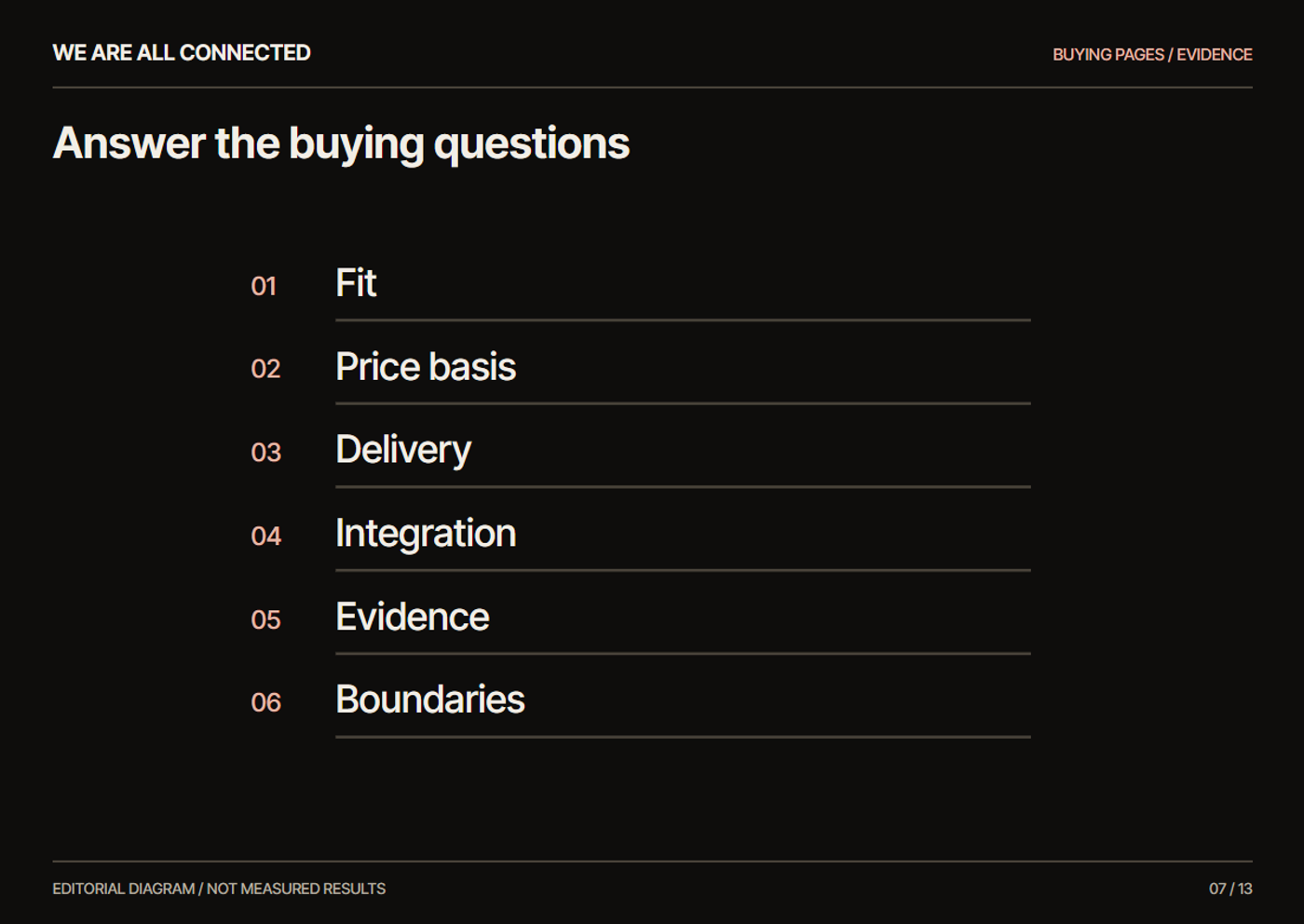
Six things, in roughly the order a buyer needs them:
- Who the offer is for, and who it is not for.
- How it is priced and what changes the price.
- What the work involves and what the client has to supply.
- How it connects to the buyer's existing tools.
- What evidence exists, and where it came from.
- What the page can't tell them yet, and who can.
GitLab, HubSpot, and thoughtbot each publish some of this detail. We checked their pages on 17 November 2026. They illustrate what a supplier can disclose. Their sales results are a separate question.
Start with fit, including who it is wrong for
If your page opens with a company introduction, a buyer still has to work out whether the offer fits.
The GitLab services catalogue lists the audience and prerequisites for training. A team can see whether it has the necessary Git experience before spending time on an enquiry.
thoughtbot groups its services by product stage and explains how its teams work remotely. A buyer with a prototype can go straight to the work that applies.
For a service page, the equivalent fields are the problem the offer solves, the kind of organisation it suits, what must already be in place, and the delivery type: advice, hands-on work, extra capacity, or an ongoing role. Then add the situations where you would advise against the engagement. Those exclusions must come from the people who run delivery, not from the copywriter's best guess. If nobody can answer, that is a task for the delivery lead before drafting starts.
Custom-priced should not mean commercially blank
Many agencies and software vendors with bespoke pricing keep the whole commercial question for a call. The buyer who wanted that answer first meets a "contact us" button.
GitLab lists Ultimate as custom-priced alongside information about its plans. It also explains that purchased credits are shared across the team and that billing depends on the plan and commitment. Even without a price for their own contract, a buyer can see which questions to take to procurement.
For a service business, the useful disclosures are:
- The charging basis: time, deliverable, retainer, or a mix.
- What usually moves scope up or down.
- What is included, what is excluded, and which third-party costs sit outside the fee.
- How a quote is built and what happens after the enquiry.
Keep three things apart: a real starting price, an illustrative budget, and a firm quotation. Publish a figure only if a commercial owner will stand behind it. If you can't publish amounts, say what information you need to price the work and how long that normally takes. A page that explains the quote process beats one that hints at a number it won't defend.
HubSpot’s onboarding page names the factors that shape its plan, including the customer’s goals, organisational complexity, products, and existing technology. These tell a buyer what to prepare. They don’t tell them what the fee will be.
Show what implementation asks of both sides
Buyers worry about delivery because the unknowns sit mostly on their side of the table: access, approvals, people's time, data. A page that describes only what the agency does leaves the harder half unsaid.
Take onboarding. HubSpot describes technical and strategic guidance and links out separately to migration services. If you offer onboarding, spell out who moves the data, who configures the software, and who checks it before launch.
For your own page, we suggest these fields:
- What you need from the client before work starts, including access and information.
- The named client-side role that owns decisions.
- Activities and deliverables.
- Indicative milestones, with the assumptions each depends on.
- Training, support, and handover at the end.
Where timing varies, say what it varies with. A single launch date is less useful than a short statement of what pushes the schedule out.
Explain how it fits the stack
"Integrates with" and a row of logos tell a buyer very little. A technical evaluator wants the product and version, the mechanism, what data moves and in which direction, and who is responsible when it breaks.
GitLab’s Jira documentation distinguishes the available integrations and explains that information from a private GitLab project can be shared with users who have access to the Jira project. That detail gives the buyer’s security reviewer something specific to check.
For a service business the principle carries over. Name the supported tool or version. Say whether the link is a supported connector, an available API, or a proposed bespoke build. Describe the data and permissions involved. Link to maintained documentation instead of copying a matrix into marketing copy that will go stale. If you haven't confirmed compatibility with the buyer's particular set-up, say it is unconfirmed. That is a more useful answer than a logo.
Give the buyer evidence they can inspect
A first-party claim and an independent check are different things, and a good page lets the reader see which one they are looking at.
thoughtbot’s services page lets readers follow a testimonial to the full review on Clutch. The link gives a buyer somewhere to check the context of the quote.
Our recommendation is to attach each important promise to the kind of source that fits it:
- A permissioned case study with the baseline, period, scope, result, and what the result can't be attributed to.
- A sample deliverable the buyer can open.
- Product or service documentation.
- A customer statement, clearly attributed.
Describe a capability as a capability. To claim a result, show the evidence and say what it covers. If the evidence is confidential, explain what the buyer can see and at what stage.
Make the facts findable, and be realistic about Google
Everything above is aimed at a person, or an assistant helping one. It is fair to ask what it does for visibility in AI answers. Less than the industry would like to claim.
Google’s guidance for its AI search features says supporting links come from indexed pages eligible to show a snippet. Keep important information in visible text and make the page easy to reach through internal links. Google’s structured data rules also require the markup to match what readers see. None of these steps guarantees a citation.
So the page-level job is to put concise, labelled answers on the offer page and link to deeper material on delivery, technical conditions, and evidence. We cover structure in our guide to doing AEO properly in 2026 and passage-level construction in the passage-first content model. This piece adds the commercial content those structures should carry.
Nothing in the sources we reviewed supports saying that an unpublished price makes a company invisible to assistants, that pages with every item above are cited more often, or that custom pricing should be marked up as zero. Don't publish those claims, and be wary of anyone who does.
Use a scorecard, then fix the gaps
Pick one real offer and go through the six areas with the commercial, delivery, and technical owners in the room. For each question, record one of five states: verified and public, verified but not public, unknown, needs verification, or not applicable. They are not interchangeable. "Contact us" on a page tells you nothing about the pricing model, and "not public" is only a valid answer when the person who owns it knows what it is. A gap on the page might mean any of these, and each leads to a different action: publish, withhold deliberately, research, or confirm.
The worksheet has 18 prompts. Use one copy per offer. Record the source, owner, and next action for each answer. If a price is deliberately private, the useful action may be to explain how a quote is prepared. If nobody knows which integrations are supported, the technical owner has something to verify.
Download the blank buying-page scorecard (CSV). The optional 0–2 rating is for discussing one answer at a time. Leave the scores separate and tackle the gap most likely to stop a buyer making a decision.
After the next few sales calls, look at which questions still come up. If buyers keep asking who handles migration, you know exactly which part of the page to revisit.
Want to make this practical?
Book a call and we will walk through your current stack, what is worth wiring first, and what should wait.
Book a call