When AI gets your business wrong: a correction and recheck workflow
A buyer sends a wrong answer about your business. Follow it back to its sources, choose the right correction route, and keep a record your sales team can use.
Imagine a sales lead forwards a screenshot. An AI assistant has quoted last spring’s price and credited your company with a competitor’s certification. The prospect has two concrete reasons to doubt you. Your team needs to establish the current facts and work out where the errors appeared.
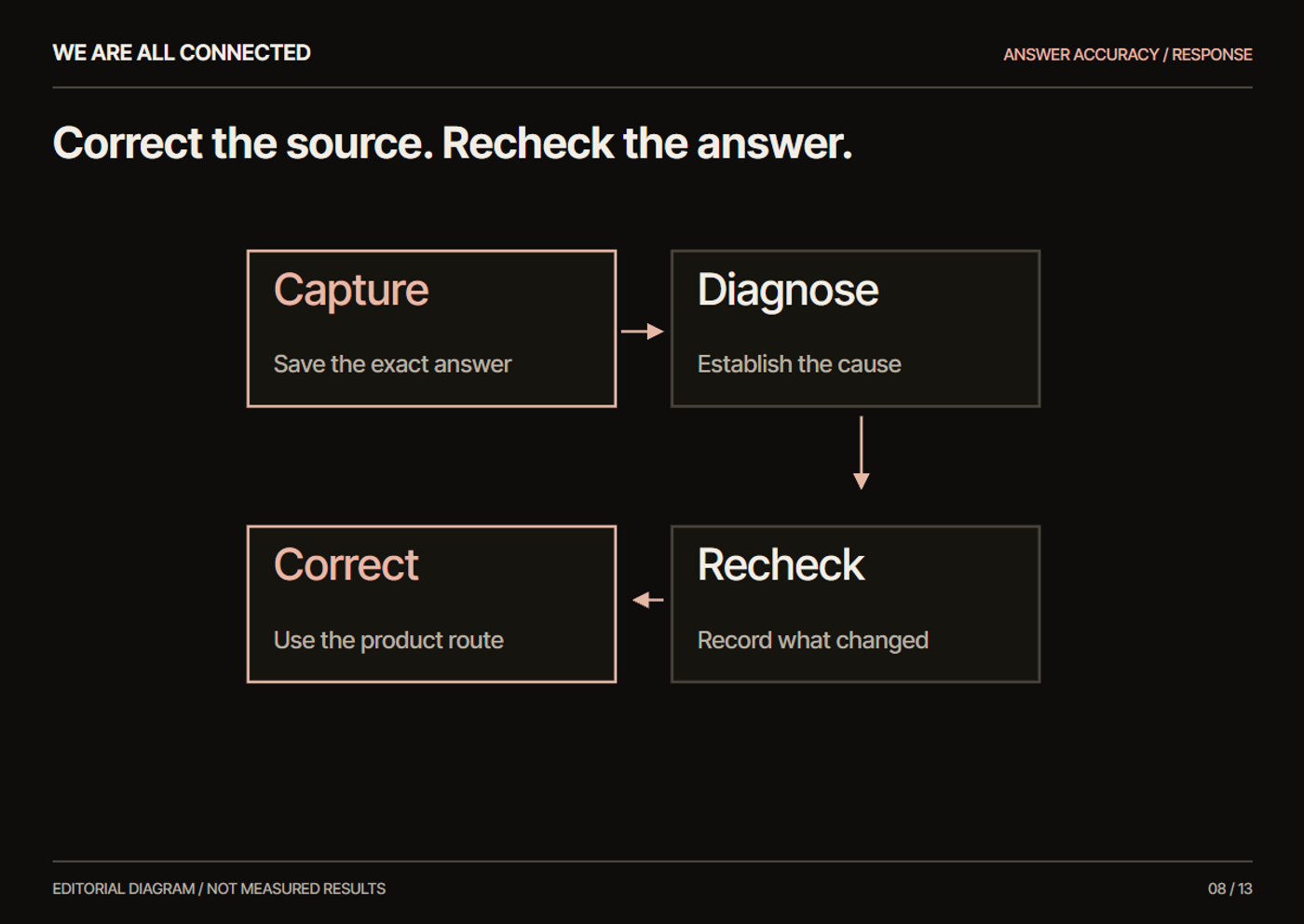
Start with one disputed sentence. Save the answer and its sources, establish who owns the fact, and correct whatever you have authority to change. Then repeat the original question and keep a dated record of what the assistant says.
You can fix an incorrect price on your own site. You can also flag a bad answer. Neither gives you control of the next response. Google describes the conditions for a page to appear in its AI search features, and OpenAI gives guidance for appearing in ChatGPT search. Both make clear that meeting those conditions offers no guarantee of placement.
We propose the following workflow for a marketing or sales team handling an error. It draws on the products’ published guidance. We have not tested it as an intervention or measured whether it changes later answers.
Capture the claim before you argue about it
Save enough detail for a colleague to check the claim independently. Five details matter.
- The exact question and answer.
- The date and time, product, visible model name, language, and location.
- The disputed sentence and any source the answer cited.
- The correct fact, its effective date, and the document that establishes it.
- The person responsible for that fact and the person authorised to act.
ChatGPT search can rephrase a question, draw on enabled memories, and use approximate location. A colleague in a different office may get a different answer even with the same wording.
Give a wrong price or a false certification an owner today. A choice of adjective can usually wait. Take safety, confidentiality, or rights questions to the person responsible for them before sharing evidence outside the business.
Is the source wrong, or the answer? Four diagnoses
Use the closest description below. These are working labels for what you can see. Leave the cause open when the evidence is unclear.
Source error. Open the cited page and find the passage. If it shows the retired price, you have identified a source that needs attention. OpenAI and Microsoft both recommend checking an answer against its sources.
Unsupported claim. The cited page is accurate, but the answer attributes something to it that it never says. Keep the disputed sentence and the source passage side by side. Changing accurate information could introduce a second error.
Stale source or index suspected. An older version of a page supports the answer, and the live page has since changed. Be careful with the word "suspected". You can see the live page. You usually cannot see what a search index holds, so the index half of this diagnosis stays a hypothesis until a documented tool says otherwise.
Entity mix-up. The answer blends another organisation's facts with yours, perhaps because of a similar name or a shared product term. Note the domain, the trading and legal names, the location, and any product identifiers, then verify each disputed attribute. This is a hypothesis about a symptom, not proof of how any entity database works.
Mixed causes are possible, so "mixed" or "unresolved" is a legitimate answer. If the response shows no citations, you cannot tell whether the problem came from retrieval or from somewhere else, and you should say so in the log.
Which sources can you correct, and who decides the fact?
Start with pages you control. Ask the fact owner to confirm the wording and effective date. Find each place that publishes it, then reconcile the current versions. Keep genuinely historical information dated.
Be honest about who holds authority. Your website is the deciding record for your pricing, not for whether a certifier has awarded you a certification. For facts like that, the authoritative record is the certifier's, and a third-party publisher that has copied it wrongly needs a polite, evidenced request for a factual correction, not a demand. Keep genuine history dated rather than deleting it because the position has changed.
Update the visible page first and bring its structured data into line. Google’s guidance says its AI search features require no special AI text file or schema markup.
Which correction route fits which product?
Choose the route that fits the error. Getting a web page recrawled and reporting a generated answer are different requests.
Request a Google recrawl of your own page
After updating a page you manage, an owner or full user of the Search Console property can request indexing through URL Inspection. Google says crawling may take days or weeks and repeated requests do not speed it up. There is no corresponding deadline for an AI answer to change.
Temporarily hide a Google result from a site you manage
Use the Removals tool if you need to hide the result temporarily. Arrange any permanent change on the site itself. A temporary removal is no promise about a future AI answer.
Refresh an outdated Google result from another site
If a third-party page has disappeared or its relevant text has changed, check Google’s guidance on outdated content. If the disputed text is still on the live page, ask its publisher for a factual correction first.
Report a Google AI Overview
Google’s AI Overviews help describes the thumbs-down control and the option to report a problem. Google receives the recent query and its results with the feedback. Submitting a report gives you no replacement answer or response deadline.
Flag an outdated Bing result
Microsoft’s Bing search guidance points to the Content Removal Tool when information removed from a page still appears in results. Use the feedback route below if the problem is in a Copilot answer.
Flag a response in consumer Microsoft Copilot
Microsoft documents Give feedback in Settings, a flag beneath an answer, and a long press followed by Report in the mobile app. This guidance covers consumer Copilot. A managed Microsoft 365 service has its own support arrangements.
Give feedback on a ChatGPT response
Use the thumbs controls on the answer. Before submitting, check the workspace and read OpenAI’s data controls guidance. Keep identifying or confidential material out of the feedback.
Product menus change. Google flags that some settings in its AI Overviews help may look different on screen. Follow the current product guidance when you submit.
On an individual ChatGPT plan, response feedback can allow the whole associated conversation to be used for training even after an opt-out. For Business, Enterprise, and Edu workspaces, feedback alone does not permit that use. OpenAI explains the distinction and the effect of a separate organisational agreement.
A useful submission can be short. Quote the disputed claim, give the correct fact and its effective date, link to the authoritative source, and say where the answer departed from it.
How do you recheck without fooling yourself?
A dated screenshot can show what you saw. Keep three separate records so a change in one never gets mistaken for a change in the others.
Record them in three lanes:
- Source corrected. You can verify this directly on the live page, and you should log it even if the assistant remains wrong.
- Index status. Record what an authorised search tool tells you. If you cannot see the status, write “unknown”. Google distinguishes requesting a crawl from inclusion in its results.
- Answer observed. Repeat the original buyer question in a fresh conversation, with the same conditions you recorded the first time.
A second question can help diagnose the error. For example, ChatGPT lets you ask it to search using a particular source or date. Keep that guided answer apart from the fresh run of the buyer’s original question.
Use the same product, language, and location where possible, and record what differed. Pick a follow-up date that reflects the harm and the date the source changed. Keep responses that are still wrong, inconclusive, or absent alongside any correct one.
The Tow Center researchers ran each query once and acknowledged that repeat results can vary. One correct answer is worth logging. It cannot establish that your edit caused the change or that the next buyer will see it.
How should you close the case?
A colleague should be able to open the case a month later and see the decision. Copy these fields into a sheet: case ID, date, product and settings, exact question, disputed sentence, source it cited, verified fact and date, fact owner, action taken, later answers, reviewer, and next review trigger.
In the pricing example, the closure note might read: “The pricing page now gives the current amount. ChatGPT returned it on both dated rechecks. We still have no citation for the certification claim. The compliance lead will check that item after the certifier responds.” The two facts deserve different outcomes.
One person can capture the answer and make the authorised site edit. Have the person responsible for the fact confirm it, and name whoever reviewed the closure note.
How common is this, really?
The EBU and BBC’s 2025 news study evaluated 2,709 answers to its core questions from four consumer assistants. At least one significant issue appeared in 45% of responses. That category covered several problems, including sourcing and context. The study covered 18 countries and 14 languages and did not evaluate Google AI Overviews or AI Mode.
The Tow Center gave eight search tools 1,600 news-excerpt queries from 20 publishers. On more than 60% of queries, the tools returned an incorrect answer to the task of identifying and citing the article. Describing your pricing is a different task.
These studies give a reason to check sources. Neither estimates your own error rate or tests whether the workflow above changes an answer.
What to do this week
If a salesperson has already spotted an error, capture the answer today and pass the disputed fact to its owner. If you are preparing in advance, give each fact a home. Who confirms prices, certifications, supported integrations, and office locations?
For the wider work of making your public information easier to find and verify, see our guide to answer engine optimisation.
Want to make this practical?
Book a call and we will walk through your current stack, what is worth wiring first, and what should wait.
Book a call