The impact of RevOps on sales and marketing alignment: a guide for the age of AI
RevOps aligns marketing, sales, and the CRM so the revenue engine works as one. In 2026 the buyer, the reps, and the marketers all use AI, which makes the alignment work more urgent, not less. Here is what has changed since 2024 and the checklist we use.
Sales and marketing misalignment still costs revenue: Forrester's 2021 research found aligned organisations grow 19% faster and are 15% more profitable. What has changed is the buyer and the stack. 67% of B2B buyers now prefer a rep-free experience and 45% used AI during a recent purchase (Gartner, 2025-26 survey), while AI agents now sit inside the CRM and any assistant can read it through MCP. AI does not fix misalignment; it runs whatever gap you have faster. This guide keeps the 2024 structure (causes, impact, principles, checklist, steps) and updates every section for teams where both sides and the buyer are using AI, with every statistic sourced and dated.
How does RevOps align sales and marketing in the age of AI?
RevOps aligns marketing, sales, CRM, and reporting around shared definitions, shared data, and one view of the buyer. In 2026 that means agreeing lifecycle definitions before adding agents, capturing self-reported attribution on every form, routing on declared intent rather than points, connecting both teams' AI assistants to the same CRM through MCP, and keeping a named human owner for every agent.
Revenue Operations, or RevOps, is the discipline of aligning your marketing, sales, CRM, and reporting systems so the whole revenue engine works as one. Done well, it gives both teams the same definitions, the same data, the same view of the buyer, and, increasingly, the same AI tools reading the same records.
The case for it has not weakened. Forrester's 2021 Return on Integration research found that organisations which successfully align product, marketing, and sales grow 19% faster and are 15% more profitable, and that finding has held up better than most of the statistics quoted alongside it (more on that below). What has changed since we first wrote this guide in 2024 is everything around it. Buyers now do most of the journey without you: 67% prefer a rep-free experience and 45% used AI during a recent purchase, according to Gartner's survey of 646 B2B buyers. Your sales team is using AI. Your marketing team is using AI. Your CRM has agents inside it that will research, score, and email prospects without asking. None of that fixes misalignment. Most of it makes misalignment faster.
Enter RevOps. In this guide we look at why sales and marketing drift apart, how AI has changed each cause, what the buyer now expects of both teams, and the checklist we use to bring them together, in that order, because the order matters.
Why are sales and marketing misaligned in 2026?
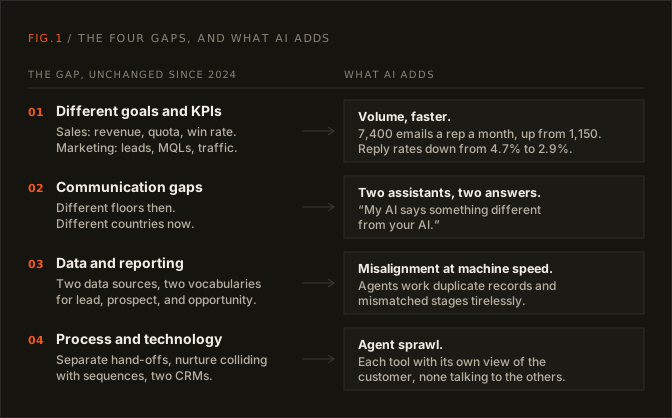
Recognising that there is a problem and then taking the time to understand it means you are over halfway to solving it. So let's get stuck in. Why are your sales and marketing teams misaligned? The four causes we came across most often in 2024 are still the four causes. What has changed is what AI does to each of them.
1. Different goals and KPIs
Sales is measured on revenue, quota, new customers, deal size, cycle length, and win rate. Marketing is measured on lead volume, lead quality, MQLs, acquisition cost, traffic, engagement, and return on marketing investment. That is a natural result of what each team does all day, but it means marketing can feel its job is done when the lead is handed over, and sales can regard marketing's results as vanity metrics. What does it matter if website visits are up 50% year on year when the number of customers is flat?
What AI adds. AI makes it trivially cheap to hit a volume target. A marketing team can generate far more content, and an outbound tool far more email. One industry dataset quoted by Salesmotion puts per-rep monthly outbound at roughly 7,400 emails after AI adoption, up from 1,150, while reply rates fell from 4.7% to 2.9%. If the KPI is volume, AI will deliver volume, and the other team will inherit the mess.
2. Communication gaps
If your business is not encouraging the two teams to talk to one another, miscommunication is the natural result. When we hear a marketing team deriding sales performance, or a sales team that only uses lead data it sourced itself because marketing's leads are rubbish (to put it politely), we can be fairly sure those people rarely get in a room, or on a call, together. Remote and hybrid working has not helped. In the past they may have been on different floors; now they can be in different countries.
What AI adds. Both teams now have AI summarising their calls, drafting their emails, and answering their questions, and each team's assistant is usually reading a different set of records. The conversation that used to start with "your report doesn't match mine" now starts with "my AI says something different from your AI". Same argument, faster.
3. Data and reporting issues
Sales and marketing often use different data sources and reporting tools, which makes a unified view of performance almost impossible. They frequently lack a shared vocabulary too. When marketing defines a lead, a prospect, or an opportunity differently from sales, sharing reports only causes confusion. LeanData's 2026 survey of revenue teams found 42% cite poor alignment on lead qualification as a significant gap, 29% have no visibility into what happens after the marketing-to-sales handoff, and 32% report duplicate or mismatched lead-to-account records.
What AI adds. Agents run on the data you give them. The same survey found 82% of revenue leaders agree that clean data and reliable routing must come before scaling AI, and Salesforce's 2026 State of Sales reports that high-performing sales teams prioritise data hygiene far more than underperformers (79% against 54%). Point a prospecting agent at a CRM with duplicate records and mismatched lifecycle stages and it will work those records tirelessly. That is not alignment; it is misalignment at machine speed.
4. Process and technology gaps
Disjointed processes. If sales and marketing develop their processes for lead generation, scoring, nurturing, and hand-over separately, gaps open in the customer journey. The classic example we still see is marketing running a nurture sequence while sales, told to be more "on it" with new leads, emails and calls the same people twice a week. Leads that go rapidly from potential customer to potential brand attacker.
Siloed technology. When the two teams do not share tools and platforms, day to day they lack any oversight of what is and is not working across both functions. Two CRMs is still the catastrophic case: leads contacted when they should not be, customers treated as prospects.
What AI adds. Agent sprawl. Marketing buys an AI writing tool and a chat agent; sales buys an AI SDR and a call recorder; each has its own view of the customer and none of them talks to the others. Gartner expects over 40% of agentic AI projects to be cancelled by the end of 2027 because of escalating costs, unclear business value, or inadequate risk controls, and a January 2025 Gartner poll found only 19% of organisations had made significant investment in agentic AI at all. The teams that are winning with it are not the ones with the most agents.
The buyer has changed more than either team
This is the reason alignment matters more now, not less.
Gartner's survey of 646 B2B buyers (fieldwork August to September 2025, published March and May 2026) found that 67% prefer a sales rep-free experience and 70% prefer a completely digital, self-service buying experience. Buyers consulted 7 information sources on average during their most recent purchase, and 45% used generative AI, mostly to gather information on vendors and products. They do not fully trust it: 51% think they are more likely to meet misleading information from GenAI, 49% say the same of a sales rep, and 69% prefer to validate what the AI told them with a rep before they decide.
Forrester's State of Business Buying 2026 describes the same buyer from the other side. The typical buying decision now involves 13 internal stakeholders and 9 external influencers. GenAI searches are the starting point, but buyers lean on their internal and external networks to justify and de-risk the decision, because AI answer engines often deliver incomplete or unreliable information. Procurement is a decision-maker in 53% of buying cycles, and more than 60% of buyers use a trial before they commit.
Put those two pieces of research together and the hand-off problem looks different. The buyer has already read your website, your competitors' websites, three review sites, and an AI summary of all of them before anyone in your company knows they exist. Marketing's job is no longer to generate a lead and pass it over; it is to make sure the buyer finds the right answers at every one of those steps, including the AI ones. Sales's job is no longer to inform; it is to validate, reassure, and reduce risk at the moment the buyer asks for a human. Neither team can do its job without the other's data.
What does misalignment cost your business?
1. Inefficient use of resources
Overlap and doubling up: sales sourcing its own leads instead of working the ones marketing provides; two tools bought for the same job; two reports on the same metric and an argument about which is the source of truth. In 2026 add two AI subscriptions doing the same thing for different teams.
2. Missed revenue opportunities
Without shared dashboards and a regular joint review, opportunities slip under the radar. Who is going to ask what happened to the promising lead that came in last week? To notice that the only activity in the CRM is one call that went to voicemail? LeanData's finding that 29% of revenue teams have no visibility after the hand-off is this problem, measured.
3. Lower customer satisfaction and retention
Sales and marketing speaking over each other, or not speaking at all, is not a good look for customers. On Monday your customer gets a marketing email about a new offer. On Tuesday they speak to a salesperson who knows nothing about it and is fairly confident they are not eligible. Soon you have a bunch of unhappy campers pulling up their tent pegs and heading for home. With agents in the loop, the Monday email can go to 5,000 customers before anyone reads it.
No business wants to deal with these problems. So where does RevOps come in? We will start with its core principles.
The core principles of RevOps
RevOps is a holistic approach that aligns sales, marketing, and customer success to drive efficiency and growth. The four principles from our 2024 guide still stand, and we have added a fifth that 2026 demands.
- Data-driven decision-making. Using data to guide strategies and decisions, which now means data clean enough for an agent to act on.
- Integrated technology stack. All teams use the same tools, or tools that genuinely work together, including their AI assistants.
- Cross-functional collaboration. Teamwork across departments, by design rather than goodwill.
- Continuous improvement. Regularly revisiting and refining processes.
- A human owns every agent. Every automated system that can touch a lead or a customer record has a named owner and a review step. LeanData found only 26% of organisations have enforcement mechanisms for their own operating rules, and only 50% feel confident about their AI governance readiness. The principle is cheap to state and rare to see.
How to use RevOps to align sales and marketing in 2026
By this point you have probably put two and two together and worked out what you need to do next. But we thought it would be useful to create a checklist, updated for a world where both teams and the buyer are using AI.
Create a shared strategy, goals, and KPIs
1. Get sales and marketing input on the business strategy. Both teams input into the overarching business strategy and develop a shared sales and marketing strategy before writing their own more detailed plans.
2. Set shared objectives. You can (and should) still set targets for website visits or calls made, but agree overarching objectives the two teams are targeted on together: revenue growth, customer acquisition, customer retention, lead generation and conversion, and market penetration. In 2026 we add one more, and the name is ours rather than an industry term: AI-assisted buyer coverage, meaning whether your company shows up, accurately, when a buyer asks an AI tool about your category. It is a marketing metric that sales will feel first.
3. Create joint metrics tracked in real time in shared dashboards. Set up dashboards both teams can access. The metrics have not changed much:
- Revenue: total revenue from combined efforts, revenue growth rate.
- Customer metrics: customer acquisition cost combining marketing and sales spend, customer lifetime value, retention rate.
- Lead metrics: lead volume; marketing-qualified leads, based on criteria both teams agreed and can adjust; sales-qualified leads; lead conversion rate from MQL to SQL to customer.
- Engagement metrics: click-through, social, and email engagement, in so far as they predict conversion. Which signals should marketing flag as a priority for sales?
- Sales cycle metrics: sales cycle length and win rate, particularly for opportunities that originated from marketing.
- ROI metrics: return on marketing and sales investment, and campaign performance with feedback from sales.
What has changed is who reads them. Build the dashboard once, define every metric once, and make sure the AI assistants both teams use are reading those definitions and not inventing their own.
Share or integrate all technology across both teams
We get it. Some tech is specific to one function, or has been in the business so long that nobody is getting rid of it. But at least integrate it, because the shared dashboards above are impossible without cross-platform visibility.
See sales and marketing as a shared function, and as such:
- Use one CRM and one marketing automation system. This is where a platform such as HubSpot brings the two teams together, and where the last two years have moved fastest. HubSpot's prospecting agent will research enrolled contacts and run an outreach sequence on its own, with a beta that spots buying signals and sources contacts at target accounts; since 14 April 2026 HubSpot charges $1 per lead it recommends and $0.50 per conversation its customer agent resolves, according to MarTech. Salesforce reports Agentforce revenue of $800 million a year, up 169% year on year, and says 54% of sellers have used agents with nearly nine in 10 planning to by 2027. Whichever platform you use, the agents inside it are now part of the alignment problem, because they act on the definitions and data both teams share, or fail to.
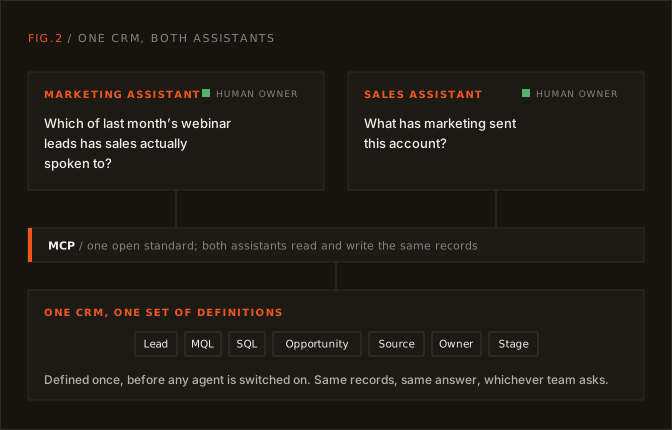
- Give both teams' AI assistants the same context. HubSpot says its remote MCP server is now generally available: it lets any compatible AI assistant, whether Claude, ChatGPT, Gemini, or Copilot, read and write your CRM through natural conversation. MCP is the open standard Anthropic published in November 2024 for exactly this. In practice it means a marketer asking "which of last month's webinar leads has sales actually spoken to?" and a rep asking "what has marketing sent this account?" get their answers from the same records. Wire the assistants to the CRM before you wire them to anything else.
- Make data consistent and accessible to both teams, ideally to the whole business. The fewer platforms, the easier this gets, and the more of the customer journey you can track end to end.
Develop standardised processes
Agreeing standard processes takes a lot of the stress out of sales and marketing communication. When it comes to the monthly review, deciding which processes to remove or improve is far less loaded than praising or criticising each individual's approach. In 2026 the list looks like this:
- Lead qualification on declared intent, not points. Most lead scoring guesses at intent by adding up points nobody trusts. Build the triggers on what buyers actually do when they are ready: a pricing-page visit combined with a demo-page visit, a second demo request, a return visit after a proposal. Route each trigger to a named person, immediately. Let the agent do the research and draft the first email; do not let it decide who is a lead.
- A hand-off with a nudge. Agree when marketing hands a lead over, when sales hands it back (a "not right now" that needs more nurture), and what happens if nobody touches it. This is where an agent earns its keep: set it to check after a day whether an inbound lead has been contacted, notify both teams if not, repeat until someone owns it, and log the outcome. That is the tedious chasing that used to be a person's job and a regular source of friction. It also works in reverse: when a lead becomes a customer, the agent stops the nurture sequence and switches on the onboarding one.
- Self-reported attribution on every form. Add an open "how did you hear about us?" field to every conversion form and read the answers alongside your touch data. Refine Labs ran a 12-month test on its own pipeline and found its attribution software credited 78% of conversions to web search while customers themselves named search only 12% of the time; customers credited podcasts, communities, social, and word of mouth instead. One company's data, and a vendor's at that, but the direction matches everything Gartner and Forrester say about buyers doing their research in places you cannot track. Without this field, marketing will keep funding the channel that gets the last click and sales will keep wondering where the good leads really came from.
- Content planned with sales feedback, including the questions buyers are now asking AI tools, which sales hears about first.
- A joint kick-off before any new campaign, and agreed timing for sales sequences and marketing nurture so they complement each other rather than collide.
Improve communication and collaboration
When it comes down to it, everything above is about one thing: better communication leads to better collaboration, which leads to better results. Three commitments make it stick:
- Set up (and keep) regular cross-department meetings, in person now and again and by video the rest of the time.
- Agree one communication channel (Slack, Teams, or the messaging inside your task tool) and bring people back to it when they drift into long email threads: "I'll copy this into the channel so we can carry on there."
- Add a standing item: what the agents did this week. Which leads they contacted, which they escalated, what they got wrong. Ten minutes, both teams, every week. It is the cheapest governance you will ever buy.
What do you get when sales and marketing align?
The benefits are already evident, but to underline them:
- Better lead quality and conversion. Shared definitions and declared-intent triggers mean sales works fewer, better leads. Default's H1 2026 survey of RevOps teams found only 25% had integrated AI across all their go-to-market functions, and that the teams applying it to routing, forecasting, and qualification, rather than to research and drafting, were the ones reporting results.
- Greater revenue and growth. Forrester's 2021 finding, again: aligned organisations grow 19% faster and are 15% more profitable. We could see similar direction in a well-run programme; we would not promise the number.
- A better customer experience. The buyer gets a rep who knows what they have already read, and never gets the Tuesday call that contradicts the Monday email.
- Higher team efficiency and morale. Fewer arguments about whose numbers are right, and fewer hours spent chasing. Salesforce's sellers expect agents to cut prospect research time by 34% and email drafting by 36% once fully implemented; even half of that is a lot of Friday afternoons.
What this looks like in practice
We replaced the case studies from the 2024 version with the pattern we actually use, because it is more useful and because we can stand behind it.
We start with a revenue process audit. We map how revenue actually flows today: every hand-off, every lifecycle stage, every place a lead dies in a queue. We talk to marketing, sales, and customer success separately, because the gaps between their answers are where the pipeline leaks.
Then we define the lifecycle and data architecture: the stages everyone agrees on, the properties that drive them, and the single source of truth for each. Lead, MQL, SQL, opportunity, source, owner, stage. If those definitions are not shared, automation just moves confusion faster, so we fix the operating model first and build the HubSpot layer on top of it.
Only then do we build the declared-intent triggers and the routing, wired from the moments a buyer signals readiness to the right person at the right moment, with the agent researching and drafting behind them. We layer self-reported attribution over the touch data so you can see which channels create pipeline and which only touch deals that were already moving. And we build the reporting your leadership will actually trust: pipeline by source, conversion by stage, velocity, and the leaks, defined once so nobody argues about them.
The useful work is usually alignment before automation. Most HubSpot problems are not caused by a missing workflow. They are caused by teams using the same words for different things.
Five steps to implement RevOps for alignment
So, you have decided a RevOps approach is the way forward. How do you start?
- Assess the current state. A gap analysis of processes, tools, and data. Moderated sessions with both teams (a cross-section from junior to senior if the teams are big), a short survey with an incentive, and a review of the data in the current platforms to find the discrepancies. Add one question to the 2024 version: which AI tools is each team already using, and what are they reading?
- Define common goals and metrics. Joint KPIs in line with the business objectives, and one definition for every term in the dashboard.
- Choose the right technology, then the agents. Tools both teams share or that integrate cleanly, chosen for visibility and ease of use (otherwise nobody uses them and you are back where you started). Only then decide which agents to switch on, in which order, with which guardrails.
- Foster a collaborative culture. Regular cross-functional communication, face to face and in one shared channel.
- Monitor, optimise, and govern. Track performance in dashboards both teams can see and comment on, and review what the agents did alongside what the people did. If an agent cannot explain why it contacted someone, switch it off until it can.
Conclusion
RevOps is more than a strategy; it is the operating model that makes AI safe to switch on. AI does not fix the gap between sales and marketing. It widens whatever gap you already have, at speed, in front of buyers who have already done most of their research without you. Align the definitions, the data, and the hand-offs first, give both teams' tools the same context, keep a human owning every agent, and the tools become a genuine advantage. At We Are All Connected we help B2B teams build exactly this, on HubSpot. If you would like a second pair of eyes on your own set-up, book a call.
Further reading
- Gartner, Gartner Sales Survey Finds 67% of B2B Buyers Prefer a Rep-Free Experience (March 2026) and 69% of B2B Buyers Turn to Sales Reps to Validate AI-Generated Insights (May 2026)
- Forrester, The State Of Business Buying, 2026 (January 2026) and the 2021 Return on Integration honours, source of the 19% and 15% figures
- LeanData, B2B State of Martech and Revenue Operations 2026
- Default, The State of AI in Revenue Operations: H1 2026
- Salesforce, State of Sales 2026
- HubSpot, Set up and use the prospecting agent and Your HubSpot context in every AI tool (MCP server and connectors)
- Gartner, Over 40% of Agentic AI Projects Will Be Canceled by End of 2027 (June 2025)
- Refine Labs, The Attribution Mirage (one company's 12-month attribution test)
- Uplift GTM, AI SDR Tools Comparison 2026: 6-Month Field Report, and Salesmotion, The Best AI SDR Tools in 2026 (the field and industry data on AI SDR reply rates)
- We Are All Connected, RevOps and HubSpot infrastructure and AI marketing operations
What is RevOps in one sentence?
The discipline of aligning marketing, sales, CRM, and reporting so the whole revenue engine works as one, with shared definitions as the precondition for any automation.
Do we need HubSpot for this?
Our own builds are on HubSpot, and our engagements are for teams already on it or committed to moving to it. The principles in this guide apply on Salesforce or Pipedrive too; the platform matters less than the definitions and the data underneath it.
Will AI agents replace our SDRs?
Not on the evidence so far. Uplift GTM's six-month test of autonomous AI SDR tools reported reply rates around 2% and 20 to 40 hours a month of human supervision per platform, and Gartner expects over 40% of agentic AI projects to be cancelled by the end of 2027. Agents that research, draft, and chase, with a person deciding, are working; agents that sell on their own are not, yet.
What is self-reported attribution?
An open "how did you hear about us?" question on your forms and in discovery calls, recorded in the CRM and read alongside tracked attribution. It captures the channels software cannot see: word of mouth, podcasts, communities, and AI answers.
How long until RevOps changes show in the pipeline?
Faster than content or search work. Lifecycle changes and declared-intent triggers can show visible pipeline movement within a couple of months of going live, and self-reported attribution starts revealing hidden channels within weeks. That is a scenario under stated assumptions, not a promise; how much depends on how misaligned the starting point was.
Want this wired into your stack?
Book a call and we will walk through your current setup, what it would take to stand something similar up, and what the first 90 days would look like.
Book a callWe put this into practice for clients through our RevOps and HubSpot service.