What is generative engine optimisation (GEO)?
The paper that named GEO reported a visibility gain of up to 40%. What did it measure, and what can a B2B marketing team do with that finding?
Generative engine optimisation (GEO) means working to make a source easier for an AI search service to find, understand, and cite. A 2023 research paper gave the practice its name. At We Are All Connected, we use the same practical approach for GEO and answer engine optimisation (AEO). Both start with sound search engine optimisation (SEO).
If someone offers a 40% lift from GEO, ask: 40% more of what? The researchers measured how prominently a source appeared within an answer. A finance director deciding how to spend next quarter’s budget needs a different measure. Here’s how to read the result before using it to plan.
Where does the term GEO come from?
Pranjal Aggarwal and five co-authors posted GEO: Generative Engine Optimization on 16 November 2023. The paper was subsequently published at KDD 2024. It asked what a publisher could change on a page to get more of its material represented in a generated answer.
The services in their discussion included Bing Chat, Google’s experimental Search Generative Experience, and Perplexity. Each combined search results with an answer produced by a language model. The researchers wanted a way to measure where the sources appeared in that answer.
What did the GEO paper test?
Their GEO-bench dataset contained 10,000 queries across 25 subject areas. Around 80% sought information. The benchmark included search queries, debate and essay questions, and questions generated by GPT-4. It had a separate 1,000-query test split.
For their main experiment they took the top five Google results for a query and asked GPT-3.5 Turbo to answer from those sources. They selected one of the five at random, edited it in one of nine ways, and compared the answer with a version using the original page. They tested changes such as adding a statistic, citing a source, or making the writing easier to follow.
Two measures mattered.
- Position-adjusted word count gave credit for the words attributed to a source, with extra weight when those words appeared early.
- Subjective impression used a model to rate seven qualities of a citation, including relevance and likely appeal to a reader. The study did not measure whether a reader clicked it.
The authors also tried selected edits on Perplexity as it operated at the time.
What did the GEO paper find?
In the main benchmark, adding quotations, relevant statistics, or citations improved position-adjusted word count by roughly 30% to 40% relative to the original. The improvement on the model-rated measure was roughly 15% to 30%. The authors also saw gains from clearer writing. These are changes in a source’s share of an answer.
A more assertive tone produced no significant improvement overall. On the Perplexity test, adding quotations raised position-adjusted word count by 22% relative to the baseline. Keyword stuffing performed about 10% below the baseline.
One frequently repeated finding comes from a different experiment. In section 5.2, the researchers edited all five source pages at once. When every page gained citations, the source originally ranked fifth gained 115.1% in measured visibility, while the first-ranked source lost 30.3% on average. Those numbers describe a redistribution among five edited pages. They cannot tell you what will happen if you edit your page alone.
What does the GEO paper not show?
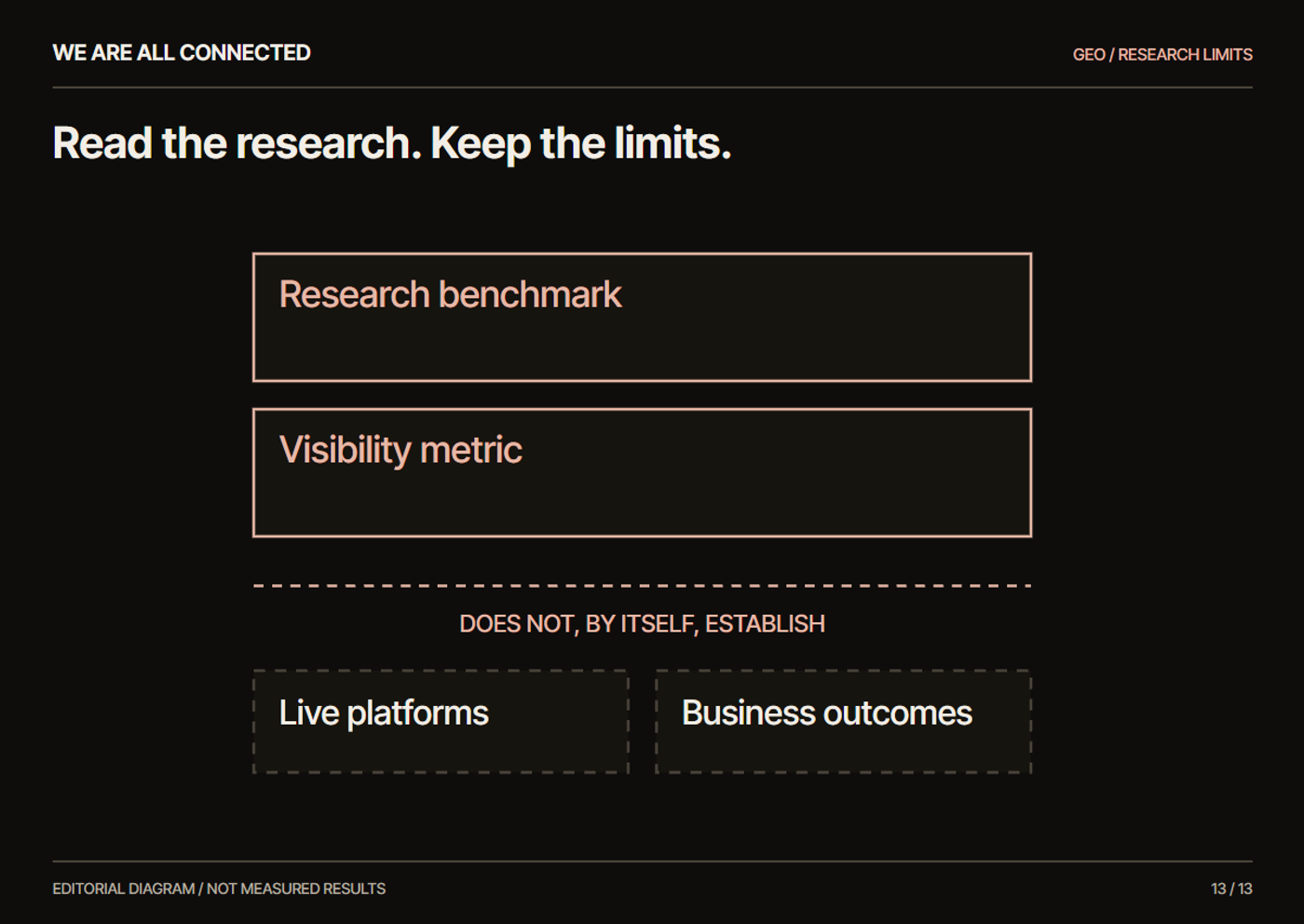
- The study tracked prominence in a generated answer. It did not follow anyone from an answer to a site, an enquiry, or a purchase.
- The shares in each answer add up to one. One source gaining a larger share leaves less for the others. That matters when reading the fifth-place result.
- The systems have changed since the researchers ran their tests. The paper cannot tell us how Google’s AI Overviews, AI Mode, or ChatGPT search will respond to the same edits today.
- The benchmark covered general web questions. The researchers did not report a separate result for B2B buying decisions such as choosing payroll software.
- The experiments changed words on the page. They did not test schema markup or measure whether an edit changed the page’s search ranking.
As a publisher, you also have to ask whether a figure is true. The researchers’ visibility measures tell you how much of a source the system used. They do not certify that an extra statistic or a confident quotation is accurate.
How has the term been used since 2023?
Google’s guidance treats AEO and GEO as labels for work on AI search visibility. For Google Search, improving that experience remains part of SEO.
Mahe Chen and colleagues later compared sources used by AI search tools and Google. Their 2025 study found that the AI services in their sample favoured third-party sources over brands’ own pages and social posts. That was a comparison of sourcing patterns. It did not retest the edits in the original GEO paper.
Is GEO different from AEO?
We plan one programme. Buyers need to find the page, understand its answer, and check the evidence behind it. Separate names for search experiences rarely justify separate versions of that work. Our comparison of AEO, SEO, and GEO explains where the practical differences do lie.
What should a B2B team take from the GEO research?
- Give buyers evidence they can check. Cite the original source for a figure and give its date. If a quotation matters, name the speaker and give enough context to understand it.
- Edit the passage that answers the buyer’s question. For a payroll integration, for instance, name the supported product and explain which records it exchanges. That gives a buyer something useful to verify.
- Use a search term where it helps the reader. Repeating it to make a page sound more relevant did poorly in the original experiment.
- Choose your own measure before the edit. Track which buyer questions you tested, which answers cited the page, and what the answers got right. Record enquiries separately.
- Check what credible third parties say about the same facts. If a buyer finds different compatibility or pricing information elsewhere, you have something worth investigating even before a visibility score moves.
FAQ
Who came up with generative engine optimisation?
Pranjal Aggarwal, Vishvak Murahari, Tanmay Rajpurohit, Ashwin Kalyan, Karthik Narasimhan, and Ameet Deshpande introduced the term in their November 2023 paper.
Does GEO work?
Some edits increased the share of an answer attributed to a page in the original benchmark. To find out whether they help your business, track a specific set of buyer questions and check the resulting answers. Any claim about enquiries needs separate evidence.
Related reading
Want to make this practical?
Book a call and we will walk through your current stack, what is worth wiring first, and what should wait.
Book a call